
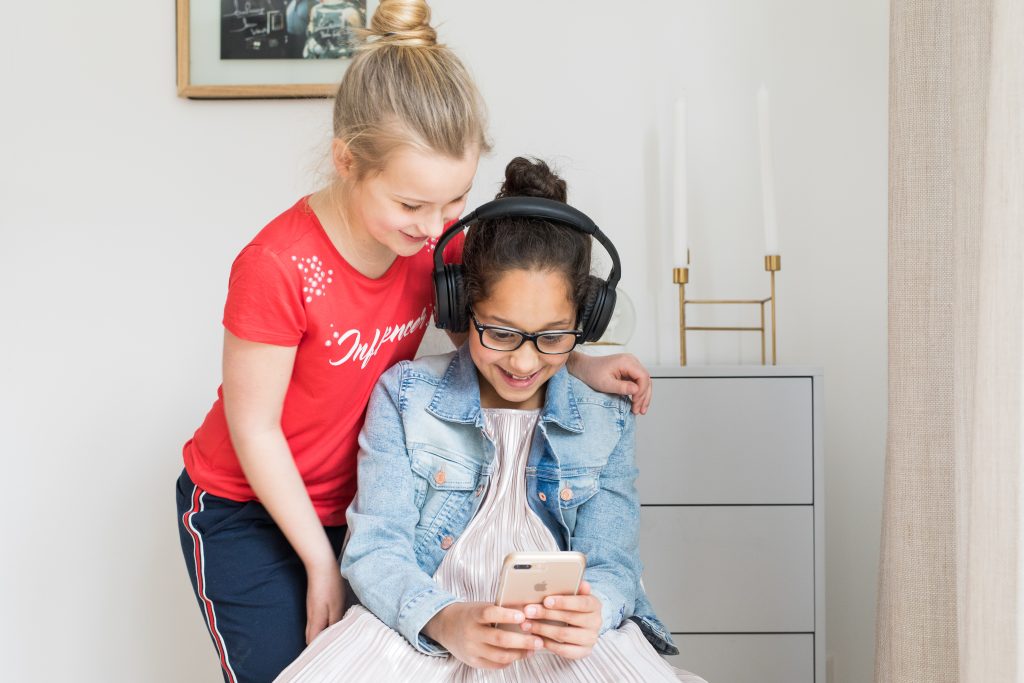
The age at which children get their first mobile phone has dropped enormously in a short time.
We now see 8-year-olds with a mobile phone and 10-year-olds with a smartphone. And sometimes they are even younger. Most children get their first smartphone just before they start secondary school.
From what age can your child have a mobile phone?
Families decide for themselves when the right moment is. Parents have very different views on this. One parent wants to put off giving their child a phone for as long as possible. Another has no problem with it, or actually likes being able to reach their child at all times. Being able to call your child whenever you want can feel reassuring. Until your child does not pick up, of course. Some children ignore messages or calls from their parents because they feel too controlled.
At primary school, children do not need a phone yet. As soon as they move up to secondary school, that changes. A phone then becomes indispensable. Many schools use an app for timetable information (changes and cancelled lessons), and phones are increasingly used actively during lessons. A smartphone is also important for contact between the children themselves.
The combination of a group and social media shows itself in WhatsApp fights and distraction while doing homework. A lot happens at once in the first year of secondary school. That is why it is useful to introduce children to online communication, and the agreements that come with it, in the last years of primary school.
Which rules work for using mobile phones?
Looking at what most parents do, and at what works in parenting, these are good rules and tips to give your child.
Behave decently: no phone at the table during meals, and don’t answer your phone while you are talking to someone else. Or say: “Do you mind if I take this call?”
No phone in bed. Partly because of the radiation from contact with the mobile network and Wi-Fi, so it is better to put the phone in flight mode if you want to use it as an alarm clock. But also because of the blue light the screen gives off and the effect that has on your sleep pattern.
No phone use in class. A mobile phone is so distracting that you can no longer follow what is happening in the lesson. Then there is no point in being at school, because your brain cannot multitask (do two things at once: listen, learn and play with your phone).
No phone use on your bike. Simply because it is dangerous. A father is currently campaigning because he lost his 13-year-old son. His son was making a playlist on Spotify when he was hit by a car. It was not the car’s fault. The boy died. Everything can wait, but traffic cannot. So put your phone away in traffic and don’t wear earbuds with music either.
Don’t post photos or videos of others online that they could be ashamed of. Don’t forward images you receive of others if they look silly or are (partly) naked. Delete them from your phone.
Protect your privacy: never give your phone number to someone you don’t know well.
Ask for help if you need it. For example when something unpleasant has happened online. In the Netherlands you can do this via Meldknop.nl, for instance.
Do you check your child’s phone?
Of course you want to keep an eye on what your child does with their phone. With a primary school child, it is fine to look at their phone now and then if necessary. With a teenager that becomes trickier: they also need (and have a right to) privacy. If there is no good reason to break into their phone, it is better not to. Or look at it together; that is an option too, of course.
Source: Opvoeden.nl
Making screen time agreements together?
Mytimingcards give your child clarity and responsibility: 24 time cards, 4 bonus cards, a timer and the Mytimingcards contract.