
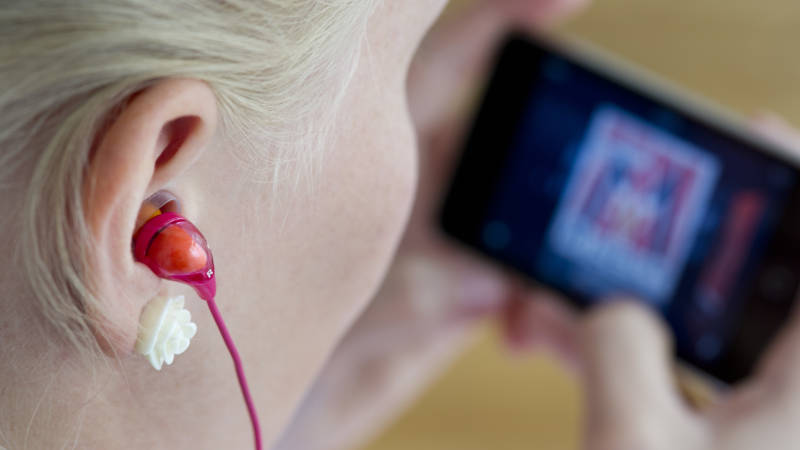
Around 14 percent of children aged about 10 have hearing damage caused by noise.
They are also more sensitive to loud sounds than their peers, or suffer from ringing in the ears. This emerged from research carried out as part of Generation R, a large-scale study by Erasmus MC in Rotterdam. The researchers gave 3,000 children an extensive hearing test.
Forty percent of these children use portable music players, such as their mobile phone. The researchers only observed the children and did not look for a direct link between the hearing damage and listening to music through headphones. “It is too early to say that one leads to the other. We would have to repeat the tests for that. But it certainly looks that way,” ENT specialist and lead researcher Marc van der Schroeff said on the Dutch radio news (NOS Radio 1 Journaal). What is clear is that children who use music players run a three times higher risk of hearing damage.
Van der Schroeff calls it shocking that noise-induced hearing loss is already found at such a young age, along with a link to the use of music players. “Especially since we are talking about 10-year-olds. We expect the noise exposure of these children to increase in the coming years, for example through events they will go to.”
Irreversible
According to the researchers, hearing loss is often irreversible; early hearing damage can build up and lead to problems at school or with behaviour, for example. “That is exactly why it is so important to know how young children’s hearing is doing and how it relates to the use of music players,” says researcher Carlijn le Clercq.
According to her, this ‘noise damage’ involves both hearing loss in the high tones and a dip in the audiogram at the pitch of speech and music. “In total, more than eleven percent of the children say they suffer from loud sounds, distorted sound or ringing in the ears.”
Generation R is a large-scale study in which Erasmus MC follows thousands of children from early pregnancy until they are young adults. The children are now 13 years old. A follow-up study has already started: Generation R Next.
Source: AD.nl
Making screen time agreements together?
Mytimingcards give your child clarity and responsibility: 24 time cards, 4 bonus cards, a timer and the Mytimingcards contract.