
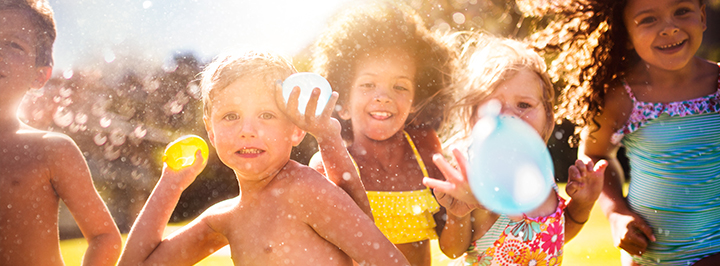
On Wednesday it is Buitenspeeldag again, the Dutch national ‘play outside day’, which aims to encourage children to play outside more. The number of children who play outside has been falling for years; 15 percent of Dutch children never do it at all anymore. Why is it so important that they do? And what are the consequences for those who don’t?
The Dutch organisation Jantje Beton was founded in the late 1960s because there were too few facilities for children in the Netherlands at the time. In those years, many new neighbourhoods full of concrete flats were built; play areas for children were in danger of disappearing or being forgotten in the new residential areas.
Half a century later, these concerns still exist, especially in the densely built-up west of the country. But a new problem has been added: the number of children playing outside has been falling for years. In 2019, one in seven Dutch children turned out not to play outside at all anymore. The average outdoor playtime of a Dutch child is now 8.4 hours a week.
New research shows that the influence of parents on whether children play outside should not be underestimated. Parents from the highest social class in particular set a bad example; they hardly spend any time outdoors themselves.
“Parents are busy and no longer have time to go outside or play with their children,” says Dave Ensberg-Kleijkers, director of Jantje Beton. “Children follow their parents; you see that with smartphone use too, for example. If adults don’t take time to relax and spend time outdoors themselves, their sons and daughters will do so less as well. Instead, they will just stay indoors and game.”
Adults should make more conscious agreements with their children, Jantje Beton argues. “You could say, for example, that one hour of gaming indoors should be balanced by one hour of playing outside,” director Ensberg-Kleijkers suggests. Eye doctors even advise twenty minutes of screen, twenty seconds of looking into the distance and two hours of playing outside.
An additional problem, however, is that a striking number of parents turn out to be worried about the safety of the outdoor play environment and therefore keep their children indoors more. “Partly, some parents, especially in the big cities, have become overprotective of their children. But at the same time, this is a signal that the government, and especially local councils, need to take very seriously.”
“From an evolutionary point of view, sport and play are of course somewhat strange; by nature, humans have taught themselves to be as efficient as possible”
Martin Pet, Right to Play
Children’s brains are developing fast
Health coach Martin Pet of the vitality agency Lifeguard is an ambassador for Right to Play. Norwegian speed skating champion Johann Olav Koss founded this international organisation fifteen years ago to promote children’s health worldwide through sport and outdoor play.
“Gaming, and actually everything you can do on a smartphone, appeals to the principle of ‘instant gratification’, or quick reward,” he explains. “When you play a game and win, you feel good for a moment, and you play another game to get that kick again.”
Playing outside gives satisfaction less quickly; you have to use your own creativity and make an effort to have fun. “But the eventual effect of playing outside is much more lasting. Exercise, especially outdoors, has so many effects on your brain and your body. If we only sat still, our health would decline in every respect.”
That applies to adults too, of course, Pet confirms. “But the brain of a growing child is developing fast and needs to develop,” the health coach explains. “By playing outside, you learn exactly how social interaction works, for example. That is knowledge you benefit from for the rest of your life. And although the name suggests otherwise, it is not knowledge that children really pick up on social media.”
‘From an evolutionary point of view, moving more is strange’
The Right to Play ambassador also confirms that parents should play an important role here. But he also acknowledges that it can be hard to take that step. “From an evolutionary point of view, sport and play are of course somewhat strange; by nature, humans have taught themselves to be as efficient as possible. That makes sense if you have to chase animals and farm the land to survive. But with all our comforts we have gone too far the other way; on balance, our efficiency is now making us dumber and lazier.”
Renate de Groot, professor of biopsychology at the Open University of the Netherlands, has long researched the relationship between exercise and its effect on children’s development. “We see that exercise mainly declines when children move from primary to secondary school,” she explains. “That trend brings all kinds of health risks. But not moving has a major impact on the development of cognitive functions. If that development lags behind, a child can feel the consequences for life, starting with school performance.”
Playing outside improves maths skills
The principle is quite simple, she explains. “Your brain works better when more blood and healthy nutrients are pumped through your body, which is one of the effects of exercise.” Incidentally, this applies just as much to older people; in recent years it has been shown more and more often that exercising more counteracts the decline of the brain in older people, for example.
“In children, exercise mainly affects the development of the prefrontal cortex, which controls the executive functions,” says De Groot. “Think of planning and organising. Maths skills are also controlled in this part of the brain.”
Like Pet, the professor stresses that moving outdoors also benefits a child’s social skills. “You unconsciously gain so many experiences by playing in the street,” she says. “You become much more aware of your surroundings and learn to perceive stimuli more actively. That is an important difference from exercising in a gym or on a running track, for example.”
The scientist genuinely does not understand why parents don’t realise how many opportunities playing outside offers children. “It is a window of opportunity; with relatively little effort, you can have a big positive influence on the rest of your children’s lives.”
Making screen time agreements together?
Mytimingcards give your child clarity and responsibility: 24 time cards, 4 bonus cards, a timer and the Mytimingcards contract.